
If you have ever needed a dental implant, a root canal, or treatment for jaw pain, your Chapel Hill dentist may have recommended a Cone Beam CT scan. You might have wondered what it is and why you need it.
Traditional dental X-rays have been used for decades. They are good at showing cavities between teeth and the general health of your jawbone. But they have a limitation. They produce a flat, two-dimensional image of a three-dimensional structure. This can make it difficult to see the full picture of what is happening beneath the surface.
That is where Cone Beam CT comes in. This modern dental technology lets dentists see your mouth in a whole new way. At Chapel Hill Family & Cosmetic Dentistry, Dr. James Furgurson and Dr. Nathan White use this advanced imaging to provide safer, more precise, and more predictable care for patients throughout the Chapel Hill, Durham, and Triangle area.
We are located at 501 Eastowne Dr STE 150, Chapel Hill, NC 27514. You can reach us at 919-736-6175 or browse our website to learn more.
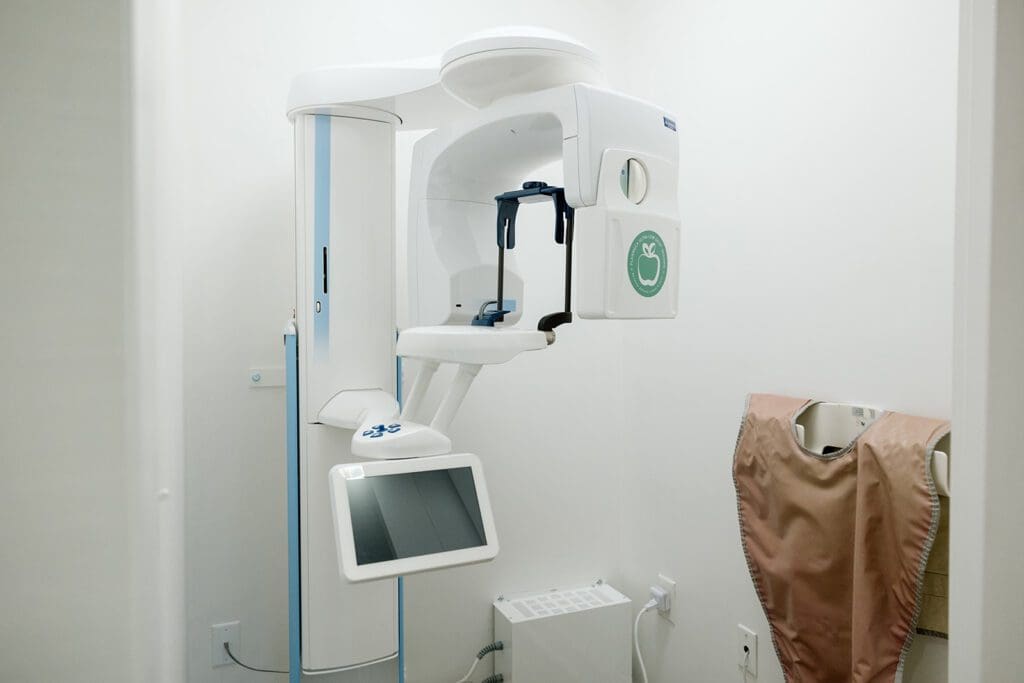
What Is a Cone Beam CT Scan?
Cone Beam CT stands for Cone Beam Computed Tomography. It’s a specialized type of X-ray that creates a three-dimensional image of your teeth, jaw, and facial structure. Unlike a traditional hospital CT scan, which uses a fan-shaped beam, Cone Beam CT uses a cone-shaped beam that rotates around your head. This captures hundreds of images from different angles in a single scan, which a computer then reconstructs into a detailed 3D model.
This 3D model is incredibly valuable. It allows your Chapel Hill dentist to see the exact position of your teeth, the shape and density of your jawbone, the location of nerves and sinuses, and even your airway. It provides a level of detail that standard 2D X-rays simply can’t match.
One study found that standard panoramic X-rays detected only 56% of anterior jaw lesions, while Cone Beam CT diagnosed 100%. This highlights how much more effective 3D imaging is at finding problems and avoiding misdiagnosis. As one expert put it, “What we can’t see, we can’t diagnose”.
Why Is Cone Beam CT Important?
The shift from 2D to 3D imaging is one of the most significant advances in modern dentistry. For patients, it means more accurate diagnoses and safer, more predictable treatment. Here are some of the key reasons dentists use Cone Beam CT.
1. Precise Planning for Dental Implants
This is perhaps the most common use of Cone Beam CT. Before placing a dental implant, your dentist in Chapel Hill needs to know exactly how much bone is available and where the nerves and sinuses are located. Cone Beam CT provides a detailed map of your jawbone, allowing your dentist to plan the implant placement with millimeter precision. This reduces the risk of complications and increases the procedure’s success rate.
Dr. Furgurson is a Fellow of the International Congress of Oral Implantologists. He uses Cone Beam CT to plan implant treatments that are safe, predictable, and long-lasting.
Learn more about dental implants here:
- Benefits of Dental Implants
- Cost of Dental Implants
- Dental Implant FAQs
- Dental Implant Process
- Dental Implants vs Dentures
- What are Dental Implants
2. More Accurate Root Canal Treatment
Root canals are needed when the nerve inside a tooth becomes infected. Traditional X-rays can show the general shape of the roots, but Cone Beam CT can reveal the intricate details of the root canal system. It can identify hidden canals, cracks, or infections that a standard X-ray would miss. This leads to more successful root canal outcomes.
3. Diagnosing TMJ Disorders and Headaches
Jaw pain and headaches are sometimes linked to temporomandibular joint (TMJ) problems. Cone Beam CT can provide a detailed view of the joint, helping dentists diagnose the underlying cause of the pain. This can lead to more effective treatment.
4. Evaluating Sleep Apnea
Sleep apnea is a serious condition where your breathing stops and starts during sleep. A narrowed airway causes it. Cone Beam CT can visualize the airway and help evaluate its size and shape. This information helps diagnose sleep apnea and create oral appliances to treat it.
5. Detecting Tumors and Cysts
Cone Beam CT can detect tumors, cysts, and other abnormal growths in the jaw that might be invisible on standard X-rays. Early detection is critical for effective treatment. The 3D images provide a clear picture of the growth’s size and location.
6. Safer and More Comfortable
A Cone Beam CT scan is fast and non-invasive. The patient sits comfortably during the scan, which takes less than 5 minutes. This makes it more comfortable than older imaging methods. The radiation dose from a Cone Beam CT is also significantly lower than from a traditional medical CT scan.
Frequently Asked Questions About Cone Beam CT
Is a Cone Beam CT scan safe?
Yes, Cone Beam CT scans are very safe. The radiation dose is significantly lower than a traditional medical CT scan and comparable to the amount of radiation you naturally receive from the environment over a few days. Dentists always follow the ALARA principle (As Low As Reasonably Achievable), meaning they use the lowest possible radiation dose needed to get the diagnostic information they need.
How long does a Cone Beam CT scan take?
The scan itself takes less than a minute. You simply sit in the machine while it rotates around your head. There is no need to bite down on anything, and you don’t have to hold still for long periods. The entire process, including positioning and the scan itself, usually takes no more than a few minutes.
Do I need a referral for a Cone Beam CT scan?
No, you don’t need a referral. Your dentist in Chapel Hill may recommend a Cone Beam CT scan during your routine exam or as part of a treatment plan for a specific procedure, such as a dental implant or root canal. The dentist will decide if this imaging is necessary based on your individual needs.
Will my insurance cover a Cone Beam CT scan?
Coverage for Cone Beam CT scans varies by insurance plan. Some plans cover the scan when it’s medically necessary for a specific procedure, such as a dental implant or oral surgery. Our team can help you understand your benefits and provide the documentation needed for reimbursement.
What does a Cone Beam CT scan show that an X-ray doesn’t?
A standard X-ray provides a flat, two-dimensional image. A Cone Beam CT scan creates a detailed 3D image that shows your teeth, jawbone, soft tissues, nerves, sinuses, and airway. This allows your dentist to see the exact position of your teeth, the shape and density of your jawbone, and the location of important anatomical structures.
Is a Cone Beam CT scan painful?
No, the scan is completely painless. You won’t feel anything during the scan, and you can resume your normal activities immediately afterward. You simply sit in the machine while it rotates around your head.
What happens after the Cone Beam CT scan?
After the scan, your Chapel Hill dentist will review the 3D images, use them to diagnose your condition, and plan your treatment. The images can be saved digitally and shared with other specialists if needed. Your dentist will explain the findings and discuss your treatment options.
How much does a Cone Beam CT scan cost?
The cost of a Cone Beam CT scan can vary by location and scan complexity. In general, the cost ranges from $250 to $500. We will provide a clear estimate before the scan and discuss your payment options. Many patients find that the clarity and precision it provides are well worth the investment.
The Chapel Hill Family & Cosmetic Dentistry Difference
At Chapel Hill Family & Cosmetic Dentistry, we are committed to using the best technology available to provide exceptional care. We are one of the few dental practices in the Triangle region with an in-office Cone Beam CT scanner.
Dr. Furgurson and Dr. White have the advanced training to interpret these detailed 3D images and use them to create personalized treatment plans. Their extensive credentials, including Dr. Furgurson’s fellowships in the Academy of General Dentistry and the International Congress of Oral Implantologists, ensure that you get care from a team with a deep understanding of complex dental procedures.
We proudly serve patients from Chapel Hill, Durham, Cary, Carrboro, Hillsborough, and all across the Triangle. Whether you need a dental implant, a root canal, or treatment for jaw pain, our advanced technology and expert team are here to help.
Call us at 919-736-6175 or request an appointment online. We look forward to welcoming you to our dental family.