Most veneer content online is written for people in their 20s or 30s. The photos show young smiles. Concerns include things like “I don’t like my gap” or “my teeth are a little yellow.” Those are real reasons to consider veneers, but they don’t tell the whole story.
Many patients who come to our Chapel Hill office asking about veneers are in their 50s, 60s, and beyond. Their reasons, teeth, and planning differ, too.
If you’re over 50 and you’re thinking about porcelain veneers in Chapel Hill, this post is for you. Here’s what changes when you’re not in your 20s, and why the conversation at our office looks different than the veneer content you’ve probably been reading.
Your Teeth Have a History Now
When you’re 25, your teeth are mostly a blank slate. When you’re 55, they’ve been through decades of chewing, possible orthodontics, maybe a few fillings, maybe a crown or two, and a lot of coffee, tea, and wine. That history matters for veneer planning.
The most common things we see in patients over 50 who are considering veneers:
- Worn Enamel: Years of chewing and grinding wear down the edges of your front teeth. They look shorter, flatter, and sometimes more even than they used to. Worn enamel means there’s less natural tooth structure for the veneer to bond to, which affects how much preparation is needed and how the final result will look.
- Recession: Gums can recede over time, especially if you’ve been brushing too hard or have a history of gum disease. Recession exposes the tooth root, which is darker and more sensitive than enamel. Veneers don’t cover the root, so if recession is significant, we need to address the gum health first.
- Existing Restorations: Many patients over 50 have fillings, crowns, or bonding from years past. Those restorations may be showing their age, and they may not match the shade of the new veneers. Part of the planning process is deciding whether to replace those restorations so the whole smile looks consistent.
- Shifted Teeth: Teeth move over time, especially if you had braces as a teenager and stopped wearing a retainer. The front teeth can drift, rotate, or develop small gaps. Veneers can address some of that, but severe misalignment may need orthodontics first, or a combination of Invisalign and veneers.
- Sensitivity: Older teeth are often more sensitive, especially around the gumline. That sensitivity affects how we plan the preparation and what we recommend for aftercare.
None of these things disqualify you from veneers, but they do mean the consultation needs to be more thorough than for a younger patient.
The Consultation Is Where the Plan Comes Together
At our Chapel Hill office, veneer consultations for patients over 50 start with a full evaluation. Dr. Furgurson and Dr. White examine your teeth, gums, bite, and existing restorations. They take digital scans with the iTero scanner, so there’s no impression material and no discomfort. They use the T-Scan to evaluate your bite and ensure the new veneers meet your opposing teeth evenly.
That evaluation informs the plan. For some patients, the plan is straightforward: veneers on the upper front teeth, carefully color-matched to the lower teeth. For others, the plan is more involved: replacing old bonding, addressing gum recession, or combining veneers with other treatment so the whole smile looks consistent.
Dr. Furgurson’s background in complex restorative care is relevant here. He’s a Fellow of the Academy of General Dentistry, which requires 500 hours of advanced training, a written exam, and three years of continuous membership. He’s also a Fellow of the International Congress of Oral Implantologists and has completed advanced training at the Misch Resnik Institute. That means he thinks about how cosmetic work fits into the larger restorative picture, not just how a single tooth looks.
Dr. White brings a conservative, evidence-based approach. He’s an adjunct faculty member at the UNC School of Dentistry and has completed advanced training through Spear Education and the Clinical Mastery Series. If he can preserve more of your natural tooth structure or achieve the result with less invasive treatment, he will.
What’s Different About the Plan
For a patient over 50, the veneer plan often includes a few things that wouldn’t come up for a younger patient:
- Gum health comes first. If you have signs of gum disease or recession, we address them before placing veneers. Healthy gums are the foundation of a healthy smile, and placing veneers on unhealthy gums is a shortcut that can lead to problems later.
- We evaluate existing restorations. If you have old bonding or a crown that’s showing its age, we’ll discuss whether to replace it as part of your veneer plan. Matching new porcelain to old composite is difficult, and the result often looks inconsistent. Replacing both at the same time creates a more cohesive smile.
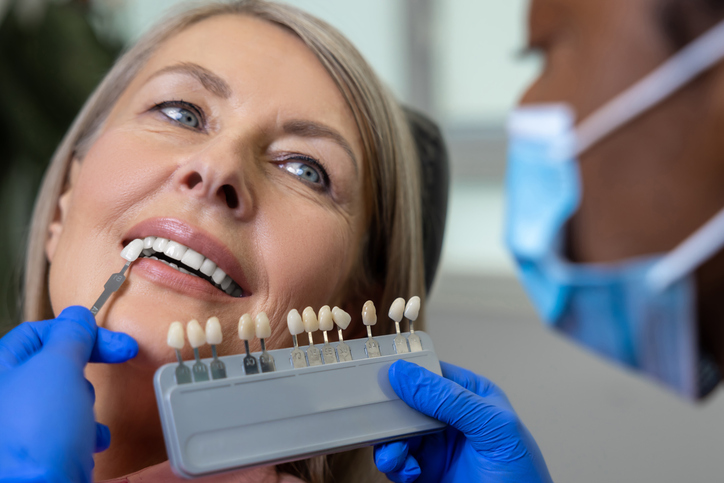
- We choose the shade with your age in mind. A very bright, opaque white looks natural on a 25-year-old. On a 55-year-old, it can look artificial. We choose a shade that complements your skin tone and the natural color of your lower teeth, so the result looks like it belongs on your face.
- We plan for the long term. Veneers placed at 55 need to last decades. That means choosing durable materials and techniques, and it means discussing habits like grinding, which becomes more common with age. If you grind, a custom night guard is part of the plan.
- We talk about the rest of your smile. Many patients over 50 consider veneers on the upper teeth but worry about the lower teeth or how their smile looks when they laugh. We’ll talk about whether a broader plan makes sense, or whether focusing on the upper teeth alone gets you the result you want.
The Emotional Side of Veneers After 50
This conversation has a part that doesn’t get enough attention. Many patients over 50 who come to us for veneers have been self-conscious about their smile for years. They’ve avoided photos, covered their mouths when they laugh, or felt like their smile made them look older than they feel.
That’s real, and it’s worth addressing directly. Cosmetic dentistry isn’t vain. It’s about feeling comfortable in your own face. For patients who’ve lived with a smile they don’t like for decades, veneers can genuinely change their lives.
At the same time, we want to be honest about what veneers can and can’t do. Porcelain veneers can improve the color, shape, and alignment of your front teeth. This treatment can cover small gaps, chips, and wear. Veneers can’t change your facial structure or turn back the clock. They can give you a healthy, natural smile that matches the rest of your face.
What to Expect at Your Consultation
If you’re over 50 and thinking about veneers, the first step is a consultation at our Chapel Hill office. We’re located at 501 Eastowne Drive, just off 15-501, minutes from the UNC campus and downtown Chapel Hill. We serve patients from Durham, Raleigh, Cary, Carrboro, Hillsborough, and throughout the Triangle.
At your consultation, we’ll take digital scans, evaluate your bite with the T-Scan, and examine your gums, existing restorations, and enamel. We’ll talk about your goals and what you’d like your smile to look like. And we’ll give you an honest assessment of what veneers can do for you and what the plan would involve.
You don’t have to commit to anything at the first visit. You just have to find out where you stand. For many patients over 50, that conversation is the first time anyone has explained what’s actually possible for their smile at this stage of life.
Call your trusted Chapel Hill dental office at 919-736-6175 or request an appointment online. Whether you’re 50, 60, or 70, it’s not too late to have a smile you feel good about.