
You finally decided to do something about your smile. You booked the consultation, you sat in the chair, and you were ready to talk about porcelain veneers. Then your dentist said, “Well, you grind your teeth, so veneers might not be the best idea.”
Then, you left with a recommendation for a night guard and a vague sense that cosmetic dentistry wasn’t for you. Either way, you’re probably wondering whether that’s actually true! Does grinding really disqualify you from veneers?
The short answer is no. Grinding doesn’t rule out veneers, but it does change the plan.
At Chapel Hill Family & Cosmetic Dentistry, we see plenty of patients from Chapel Hill, Durham, and across the Triangle who’ve been told their grinding makes them a poor candidate for cosmetic work. Most of them are good candidates. They just need a dentist who thinks about how the veneers will hold up over years, not just how they’ll look the day they’re bonded.
What Grinding Actually Does to Your Teeth
Bruxism is the clinical term for grinding or clenching your teeth. Some people do it during the day without realizing it. Most people do it at night, which makes it harder to notice. You might wake up with a sore jaw, a dull headache, or sensitive teeth. Or you might not notice anything until a dentist points out wear patterns on your teeth.
That wear is the key issue. Grinding puts enormous force on your teeth, far more than normal chewing. Over time, that force wears down enamel, flattens the edges of your front teeth, and can even cause small fractures. If you’ve ever looked at your smile and thought your teeth looked shorter or more even than they used to, grinding is the reason.
Porcelain is strong, but it’s not indestructible. If your natural teeth already show wear from grinding, adding a thin layer of porcelain without addressing the grinding is a recipe for chipped, cracked, or debonded veneers. The porcelain can fail. When it does, you’re back in the chair sooner than you planned.
That’s why some dentists say no. Veneers aren’t impossible for grinders. Veneers placed without a plan for grinding are a bad investment for everyone involved.
Why “No” Isn’t the Right Answer
A flat “no” leaves patients stuck. If you grind your teeth and you’re unhappy with your smile, you deserve more than “come back if the grinding stops.” For most people, the grinding doesn’t stop. It’s tied to stress, sleep patterns, bite alignment, and sometimes medication. Telling a patient to stop grinding is like telling them to stop clenching during a stressful week.
A better approach is to plan for grinding. That means three things: understanding why you grind, protecting your veneers from the force, and choosing materials and techniques that last.
At our Chapel Hill office, we start with a full evaluation. Dr. Furgurson and Dr. White look at wear patterns, bite alignment, jaw position, and the health of your gums and enamel. They use tools like the T-Scan to measure how your teeth come together when you bite and chew. The T-Scan shows whether your bite is balanced or whether certain teeth are taking more force than they should.
That matters for veneers because how your bite distributes force determines how much stress your new porcelain can handle. If one or two teeth are doing most of the work, veneers on those teeth will take a beating. With a balanced bite, the veneers share the load and last longer.
The Night Guard Isn’t Optional
If you grind your teeth and you want veneers, a custom night guard is part of the treatment plan. It’s not a suggestion or an upsell. A night guard is an important part of the plan.
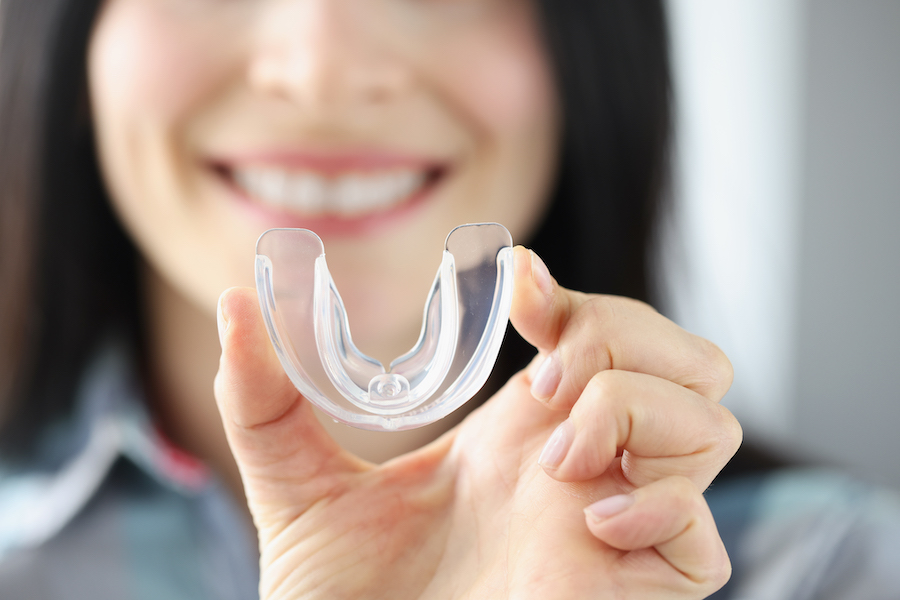
A night guard is a custom-made appliance that fits over your teeth while you sleep. It creates a barrier between your upper and lower teeth, so when you grind, the force goes into the guard instead of your veneers. Without it, the porcelain takes the full force of every night of grinding, and the odds of a chip or a fracture go up significantly.
We make custom night guards in our Chapel Hill office. We fit them to your teeth using digital scans, so they’re comfortable and stay in place. Patients from Durham, Cary, and Carrboro often tell us they were surprised by how easy it was to sleep with one, especially if they’d tried over-the-counter guards before. Those generic guards don’t fit well, and a poorly fitting guard can make grinding worse.
If you’re thinking about veneers and you grind, you can’t skip the night guard. It’s the thing that protects the investment you’re about to make. A veneer that chips because you didn’t wear a guard costs more to fix than the guard would have cost.
Choosing the Right Veneer for a Grinder
Not all veneers are created equal, and for a patient who grinds, the material matters more than it does for someone who doesn’t.
Porcelain is still the standard for veneers, and for good reason. It reflects light like natural enamel, it holds its color, and it’s durable. Porcelain thickness, how it’s bonded, and how much natural tooth structure is underneath all affect how well it handles grinding forces.
In some cases, a slightly thicker veneer or a different preparation approach gives the porcelain more support. In other cases, the answer is to address the bite first, so the veneers aren’t fighting an uneven chewing pattern. Dr. Furgurson has completed advanced training in cosmetic and restorative dentistry, and he’s a member of the American Academy of Cosmetic Dentistry. That background matters here, because planning veneers for a grinder is a functional decision.
Dr. White brings a conservative, evidence-based approach to the same conversation. He’s an adjunct faculty member at the UNC School of Dentistry, and he’s completed advanced training through Spear Education and the Clinical Mastery Series. If he can protect your natural teeth and still get the result you want, he’ll find a way. And if the honest answer is that a different treatment would serve you better, he’ll say so.
What the Process Looks Like for a Grinder
If you grind your teeth and you’re moving forward with veneers, the process looks similar to any other veneer case, with a few important additions.
In the consultation, we evaluate your bite, wear patterns, and goals. We also discuss the night guard and make sure you understand why it’s part of the plan. We’ll take digital scans with the iTero scanner, so there’s no goopy impression material, and we’ll review your bite with the T-Scan.
The treatment plan accounts for your grinding. That might mean adjusting your bite before we place veneers, choosing a specific porcelain thickness, or planning veneer placement so forces are distributed evenly across your smile.
Preparation and bonding happen the same way they do for any veneer patient. We remove a small amount of enamel, take digital impressions, and place temporary veneers while we make your permanent ones.
The try-in lets you see and feel the veneers before we bond them. We also check your bite again with the T-Scan to make sure the new porcelain meets your opposing teeth the way it should. If something needs adjusting, we do it then.
We fit the night guard after we bond your veneers. You wear it every night. It’s not glamorous, but it’s what keeps your veneers looking good in five years.
The Honest Conversation
If you’ve been told you can’t get veneers because you grind your teeth, don’t give up. Get a second opinion from a dentist who’s used to planning cosmetic work for patients with functional challenges.
At Chapel Hill Family & Cosmetic Dentistry, we treat patients from Chapel Hill, Durham, Raleigh, Cary, Carrboro, and Hillsborough. Our office is just off 15-501 on Eastowne Drive, minutes from the UNC campus and downtown Chapel Hill. We see many patients who’ve been told “no” elsewhere and are looking for a plan that actually works.
If you grind your teeth and you want veneers, call our Chapel Hill dental office at 919-736-6175 or request an appointment online. We’ll look at your bite, explain what a veneer plan for a grinder looks like, and give you an honest answer about what’s possible. For most patients, the answer is more hopeful than they expected!